Home / Technology / How Online Narratives Are Shaping Claims of Cross-Border Interference in Sudan and Ethiopia

How Online Narratives Are Shaping Claims of Cross-Border Interference in Sudan and Ethiopia

By Kirubel Tesfaye

The wars in Sudan and Ethiopia are increasingly connected by allegations of cross-border military involvement and competing political narratives circulating on social media, which risk deepening mistrust and heightening tensions in the region. 

Posts, videos and images have been used to allege that Ethiopia is supporting Sudan’s Rapid Support Forces (RSF), while other claims accuse Sudanese actors of backing Tigrayan fighters. Some of these posts present images of military camps, armed personnel and aircraft as evidence of foreign involvement. But how much do these claims actually reveal about what is happening on the ground?

An open-source investigation combining satellite imagery, geolocation, reverse-image searches and analysis of social media content examined several of the claims linking the two conflicts. The investigation assessed alleged RSF activity in Ethiopia’s Benishangul-Gumuz region, claims that Tigrayan fighters are operating in Sudan, and viral images and videos used to support allegations of military involvement. We found that some posts use old or misleadingly presented imagery to support claims about current events, while other allegations require further corroboration. 

The tensions between Ethiopia and Sudan are rooted in overlapping conflicts that have reshaped the Horn of Africa in recent years. The war between Ethiopia’s federal government and the Tigray People’s Liberation Front (TPLF), which began in November 2020, ended formally with the signing of the Pretoria Agreement on November 2, 2022. The agreement, signed in South Africa, established a cessation of hostilities and provided for the disarmament, demobilisation and reintegration of Tigrayan forces.

The conflict involved forces beyond the Ethiopian federal army and Tigrayan fighters. Amhara regional forces and Fano militias fought alongside federal forces, while Eritrean troops also participated in the war. The conflict also affected Ethiopia’s relations with neighbouring Sudan. As Ethiopian troops were redeployed from border areas to fight in Tigray, Sudanese forces moved into the disputed Al-Fashaga territory, according to reports published in December 2020. This added another source of tension along the two countries’ shared border.

The Pretoria Agreement did not resolve all of Ethiopia’s internal security challenges. On April 6, 2023, the federal government announced plans to dissolve regional special forces and integrate their members into the national defence force, federal forces or regional police. The decision triggered opposition and protests in the Amhara region, where many viewed it as a threat to regional security and autonomy.

The move came amid efforts to demobilise and reintegrate former combatants. On March 31, 2023, National Rehabilitation Commissioner Teshome Toga announced consultations on the process, including in Amhara. Armed clashes subsequently broke out in the region in April 2023, opening another front in Ethiopia’s internal conflicts.
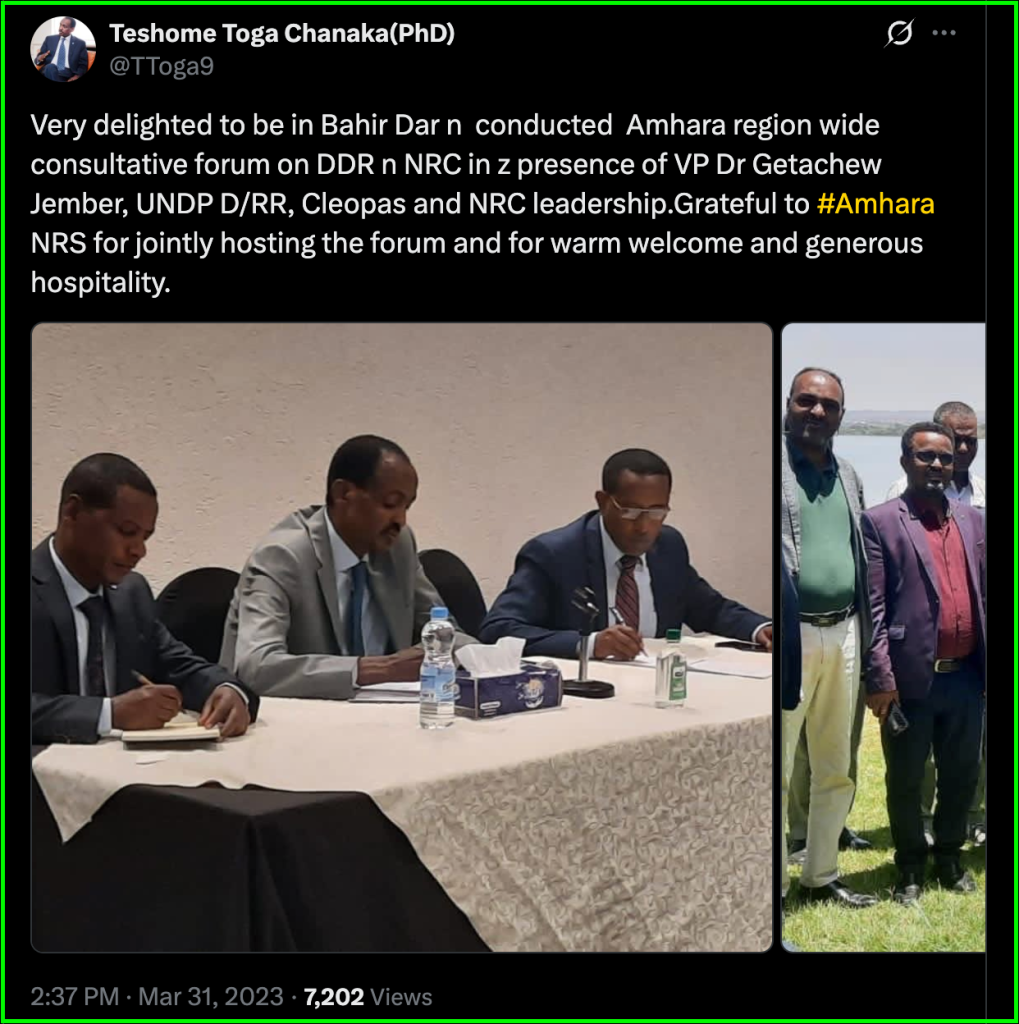
Screenshot shows a post by Tsehome Toga (PhD) about the Amhara region DDR process 
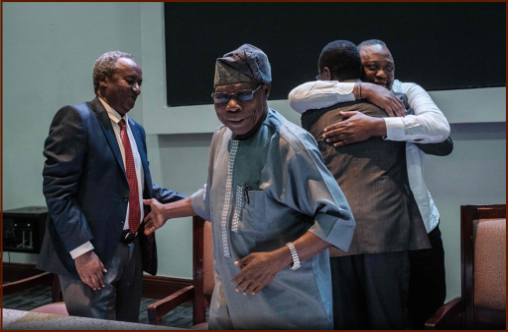
Oluṣẹgun Ọbasanjọ, General Tadesse Worede, Field Martial Birhanu Jula, Uhuru Kenyatta at the conclusion of the Pretoria agreement in November 2022

Meanwhile, Sudan descended into a separate but increasingly interconnected crisis. On April 15, 2023, fighting erupted between the Sudanese Armed Forces (SAF), commanded by General Abdel Fattah al-Burhan, and the paramilitary Rapid Support Forces (RSF), led by General Mohammed Hamdan Dagalo, known as Hemedti. The immediate dispute centred on plans to integrate the RSF into Sudan’s national army following the 2021 military coup. Fighting began in Khartoum and spread to other parts of the country, including Darfur, Kordofan and Al Jazirah, causing widespread civilian suffering, displacement and hunger.

By 2026, tensions had also resurfaced in Tigray. Following months of friction between TPLF leaders and the federal government, the TPLF sidelined the federal-backed Tigray Interim Administration in April. On August 1, heavy fighting reportedly erupted between Ethiopian federal forces and TPLF fighters near the Sudanese border, including around Shererina. Reports that civilians and wounded TPLF fighters fled into Sudan added to concerns about the regional consequences of Ethiopia’s renewed conflict.

Together, these developments provide the backdrop to a growing exchange of accusations. Allegations that Ethiopia is supporting the RSF have been met with counterclaims that Sudanese actors are backing Tigrayan forces. 

Allegations of RSF activity inside Ethiopia

Allegations that the Ethiopian government’s involvement in Sudan’s civil war gained renewed attention in February 2026 when Reuters reported that an alleged training camp in the country’s western Benishangul-Gumuz region was being used to train RSF fighters. Based on interviews with officials and other sources, satellite imagery and internal documents, the report described a camp near the Sudanese border and new infrastructure at the nearby Assosa Airport.

“The camp constitutes the first direct evidence of Ethiopia’s involvement in Sudan’s civil war, marking a potentially dangerous development that provides the RSF a substantial supply of fresh soldiers as fighting escalates in Sudan’s south,” the investigation noted.

An internal Ethiopian security note reviewed by Reuters reportedly stated that 4,300 RSF fighters were undergoing training at the site in early January 2026. Sources interviewed by the outlet had claimed that the United Arab Emirates was funding the site’s construction and provided military trainers as well as logistical support. The UAE government has, however, denied involvement in the conflict. 

In a joint statement issued on January 6 2026, the Ethiopian and Emirati governments reaffirmed their commitment to one another’s security and territorial integrity and condemned attacks against civilians.
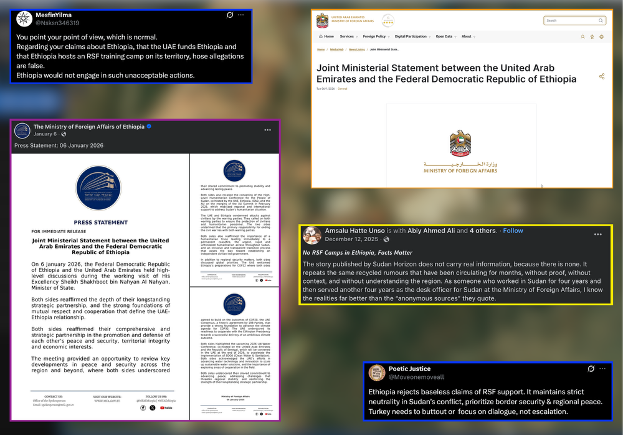
Screenshot shows a joint statement of UAE and Ethiopia about the current situation in Sudan and other posts on X

In countering the claim of the RSF training camp and the Ethiopian government supporting the RSF as a military base, certain social media posts on X and Facebook alleged that the camp wasn’t a training camp but a project associated with a gold mining area.

“Our analysis suggests these sites are far more likely to be gold mining camps currently under construction by the Ethiopian government. Imagery previously shared by the Office of Prime Minister Abiy Ahmed released several months ago to document the commencement of gold mining projects in the area closely matches the same locations and structures that Reuter now presents as evidence of a rebel training camp,” Conflict Zone (@breaking_bre) posted on X on February 10, 2026. The account’s posts typically emphasise ENDF advances, TPLF losses, and local support for federal forces, while portraying Eritrean forces in adversarial terms.

However, a simple reverse image search of the images in the post was conducted, leading us to Facebook posts shared in September by the Ministry of Mining and the Benshangul-Gumuz Prosperity Party, which associated the pictures with the Kumruk Gold mining project.

The image shared on the official pages shows a large industrial ore-processing facility with processing tanks, conveyors, pipelines, buildings, and a water-management pond beside excavated ground. Its layout is consistent with a gold-processing plant, possibly using tank-leaching technology.
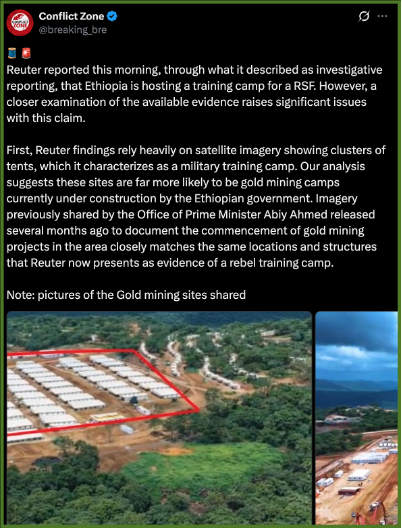
A screenshot shows a post describing allegations of the RSF-linked military training camp as false
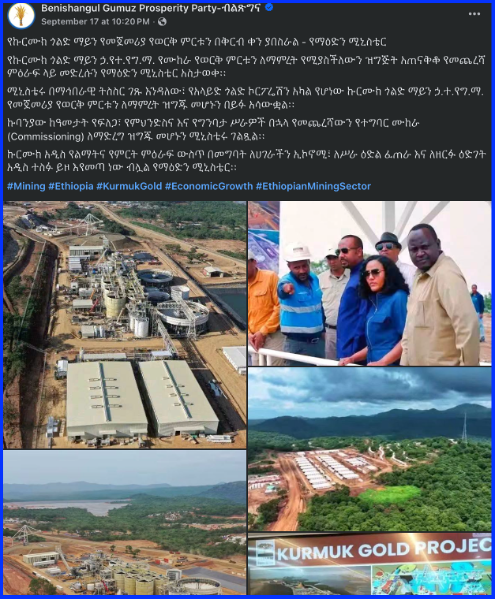
A screenshot shows a Kumruk Gold project shared by the Benshangul-Gumuz Prosperity Party. The post states, “The Ministry of Mines has announced that Kurmuk Gold Mine PLC has completed preparations and reached the final stage for its trial gold production.”

After geolocating the gold mine, we were able to determine that the alleged RSF training camp is situated a significant distance from the mining site. The shortest distance between the two locations is 54.32km (33.75 miles), indicating that the claim that the satellite image analysed in the Reuters investigation is actually showing the gold mining camps is false.
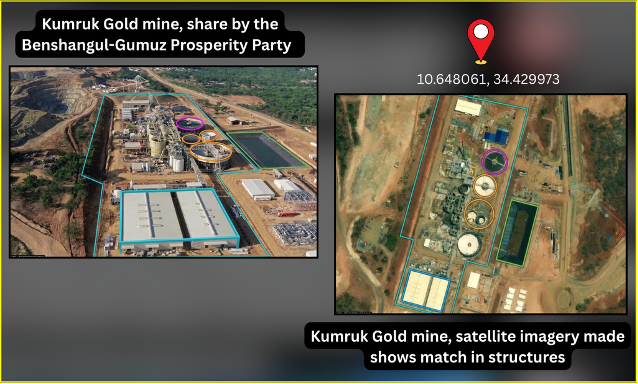
Image shows a satellite image of the Kumruk Gold project and an on-ground match
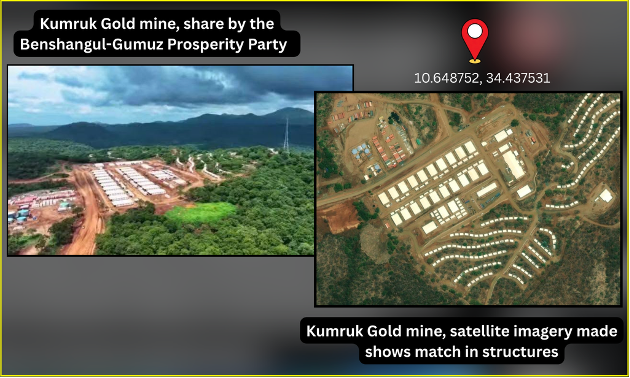
Image shows a satellite image of the Kumruk Gold project and an on-ground match 
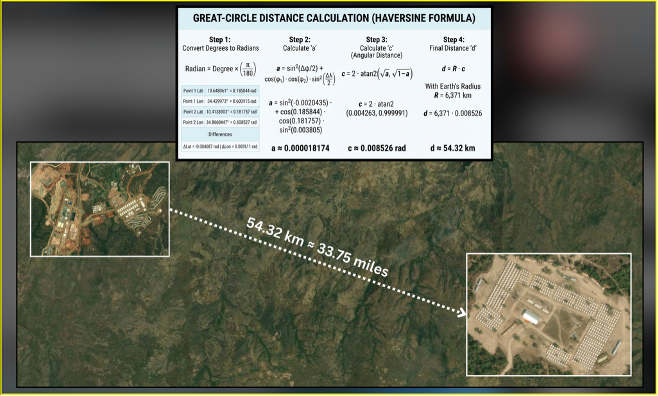
The distance between the two points and the calculation made to claim their distance

Additionally, satellite imagery of Assosa Airport from 2023 to 2026 shows changes to the site, including the construction of a hangar, an adjoining apron and additional paved areas near the runway. The most recent imagery reviewed for this investigation, dated August 5 2026, shows a metal-framed hangar connected to a paved apron.

These developments are consistent with the construction of new aviation infrastructure. However, satellite imagery alone cannot establish that the hangar was built for military purposes or that it is intended to store drones. Those possibilities require corroborating evidence.

The overlap between Reuters’ findings and the developments observed in our own imagery analysis makes Assosa Airport an important site for further investigation. Nevertheless, the construction visible in the imagery should be distinguished from claims about the airport’s operational role and any direct connection to RSF activity.

2023 Imagery 2024 Imagery 2025 Imagery 2026 Imagery 
Date: 2023-08-31Date: 2024-09-19Date: 2025-07-31Date: 2026-08-05
Direct Satellite imagery Link: Open 2023 imageryDirect Satellite imagery Link: Open 2024 imageryDirect Satellite imagery Link: Open 2025 imageryDirect Satellite imagery Link: Open 2026 imagery

A table shows the architectural and geographical differences seen at the Assosa Airport between 2023 and 2026

Our investigation also examined satellite imagery of a separate site in the Menge area of Benishangul-Gumuz, where Reuters reported that an alleged RSF training camp had been established. The location is in western Ethiopia, close to the borders with Sudan and South Sudan and approximately 101 kilometres from the Grand Ethiopian Renaissance Dam (GERD), according to our geographic measurements.

The imagery reviewed for this investigation shows hundreds of white, rectangular structures arranged in rows within a cleared area. We counted 661 structures that could be consistent with tents or other shelter-like units. A larger, light-coloured building is visible near the centre of the site. Its purpose cannot be established from the imagery alone; it could serve several functions, including administration, medical support or logistics.

The regular arrangement of the structures, the cleared ground and the presence of a larger central building are consistent with an organised encampment. They do not, by themselves, confirm who occupies the site, whether the occupants are RSF fighters or whether military training is taking place there.

A screenshot shows an alleged RSF training camp in Benishangul-Gumuz

A screenshot shows an estimate of the possible number of personnel in the alleged camp

Examining Claims of RSF Activity in Benishangul-Gumuz

As allegations circulated online about possible Ethiopian government support for Sudan’s Rapid Support Forces (RSF), the investigation examined social media content that appeared to show armed personnel in Ethiopia’s Benishangul-Gumuz region.

One TikTok account, under the username “user58457072065750”, was created on May 22, 2025 and regularly shared military-related content. At the time of the investigation, it had more than 1,300 followers and approximately 22 videos. Details about the account owner’s identity, affiliations or location are unclear, however.

A screenshot shows the statistics of the TikTok account

A screenshot shows a video shared by the TikTok account showing a multi-motor FPV drone

One of the account’s videos featured a device that resembled a first-person-view (FPV) drone, a type of unmanned aerial vehicle used in various military applications, including reconnaissance and attacks. 

Another video appeared to show the account owner alongside several armed men and other uniformed personnel. The investigation examined the possibility that the armed men were RSF members and that the other personnel belonged to Benishangul-Gumuz’s regional police. However, their identities and affiliations could not be established from the footage alone.

The investigation also compared the clothing worn by the individuals in the video with photographs published by Addis Standard showing members of Benishangul-Gumuz’s regional police during a graduation event. Some of the uniforms appeared to have similar camouflage patterns. The individuals identified as possible RSF members wore desert-patterned shirts and tan tactical trousers, while other personnel wore green, brown and black digital camouflage, with what appeared to be an Ethiopian flag patch on a sleeve.

The similarities provide a basis for further investigation into the identities of the people shown. However, camouflage patterns and uniform features alone cannot confirm an individual’s affiliation, establish where a video was recorded or demonstrate cooperation between armed groups and regional security forces.

A screenshot shows people wearing uniforms resembling those of RSF soldiers with possible members of the Benishangul-Gumuz police forces

A screenshot shows a comparison of a camouflage detected on the video (RSF and Benishangul-Gumuz police forces)

Claims of Tigrayan Fighters in Sudan

Claims that Tigrayan fighters are operating in Sudan have circulated alongside allegations that Sudan’s Rapid Support Forces (RSF) are active inside Ethiopia. These claims appear to travel through social media platforms, and each reinforces the other’s plausibility: an alleged RSF footprint in Benishangul-Gumuz invites a counter-claim of Tigrayan fighters on the Sudanese side, and vice versa.

On November 7, 2025, an account on X posted a video it described as showing a secret military camp in Sudan where the Tigray People’s Liberation Front (TPLF) was training new fighters. The footage shows hundreds of armed personnel marching in formation alongside a Tigray flag. TPLF soldiers in the video are seen carrying assault rifles and PKM-style machine guns.

A screenshot shows alleged TPLF soldiers in an unverified place claimed to be in Sudan

Some accounts on X (here, here and here) identified the group as “Army 70” and placed the alleged camp in Sudan’s Gedaref state. However, the location of the footage has not been independently established by the evidence presented here.

Other posts claimed to show Tigrayan or Ethiopian fighters captured by RSF forces during fighting around Kurmuk, in Sudan’s Blue Nile region. One video allegedly shows an older man and a boy described in posts as 15 years old. 

Another clip features a man speaking Tigrinya who appears to express support for both Sudan and Tigray. He is heard saying “ካልእ ናይ ቴክኒክ ነገራት ከይጥቀም፤ ኣብኡ ኢና ትኹረት ገይርና ዘለና ፤ ካብዚ ወፃኢ እዚ ሕብረተሰብ ናትና ደጋፊ እዩ ኣረጋጉጽና ኢና ብጣዕሚ ደስ ዝብል ሕብረሰተብ ኢና አግኒና ዘለና ሱዳን ትስዕር፤ ትግራይ ትስዕር፤ ትግራይን ሱዳንን ይስዕራ (We are focusing on ensuring that they do not use other techniques. Furthermore, we have confirmed that the public supports us. The community we found is wonderful. Sudan and Tigray will prevail).” But the language spoken, the people shown, and the claims attached to the footage do not independently establish where the videos were recorded or which forces the individuals belong to.

A screenshot shows claims of TPLF soldiers captured by RSF inside the war in Sudan

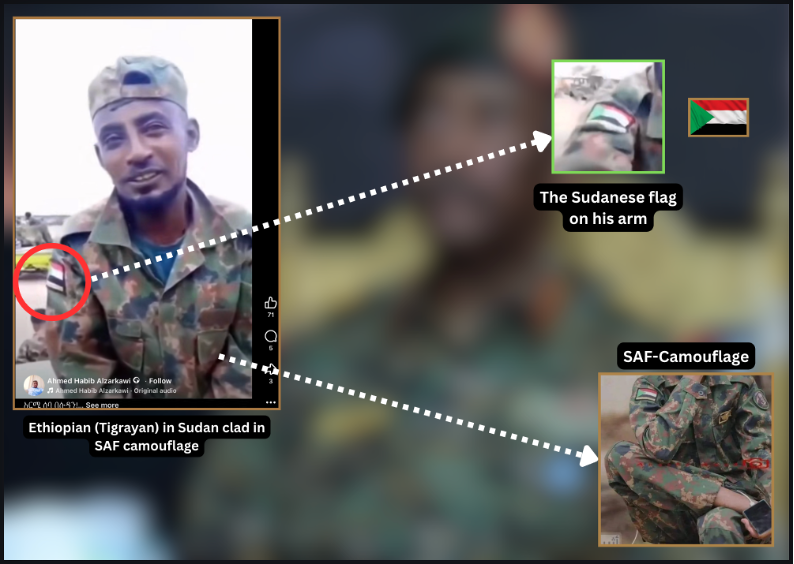
A screenshot shows an Ethiopian/Tigrayan soldier fighting along with SAF in the war in Sudan

How Misleading Images and Videos Fuel the Claims

The investigation also identified posts that used old or manipulated visual material to support allegations of military activity along the Ethiopia–Sudan border. In three cases, reverse-image searches, geolocation and image analysis helped establish that the material did not show what the captions claimed.

On January 11, 2026, posts on X shared footage described as showing Sudanese Armed Forces (SAF) airstrikes on an alleged RSF camp near the Grand Ethiopian Renaissance Dam (GERD), in Ethiopia’s Benishangul-Gumuz region.

However, using video-verification tools, including InVID, alongside reverse-image searches and location analysis, we found that the footage had appeared online earlier, on April 15, 2023, in a video published by Al Arabiya. The original report described the Sudanese army taking control of the Karari camp in Omdurman, which belonged to the RSF.

The investigation also measured the distance between Karari camp and the nearest point on the Ethiopian border, finding it to be approximately 470 kilometres. The earlier publication and location evidence contradict the claim that the footage showed a new airstrike near the GERD. 

A screenshot shows an alleged airstrike by SAF on the borders of Ethiopia. Left, Right

A screenshot shows a video shared by AlArabiya on April 15, 2023.

A screenshot shows the nearest distance measured on G.earth from Karari camp to the Ethiopian border 

In September 2026, posts on X and Facebook claimed that Sudan’s Armed Forces had captured a UAE cargo plane that entered Sudanese airspace. The posts used a photograph of a Boeing C-17 Globemaster III operated by the United Arab Emirates Air Force under the tail number 1227. (It was originally built under the U.S. serial number 10-0405 and Manufacturer Serial Number MSN 50247.)

A reverse-image search traced the photograph to JetPhotos, where it had been uploaded on February 2, 2014, with a photo date of November 13, 2013. 

While traditionally sporting the standard military grey livery with bilingual English and Arabic markings, the aircraft is also well known for its striking alternate desert tan and metallic gold special-mission livery, frequently flown under the radio callsign “GOLD 24.” This specific aircraft (1227) was repainted into a striking, highly reflective metallic gold and desert tan paint scheme. 

This distinctive finish makes it one of the most visually recognisable C-17s in operation globally. The investigation found records of the same aircraft being shown in a different paint scheme in an Instagram post published in April 2026.

And so, because the aircraft had already been recorded as repainted in late April 2026, months prior to the claims surfacing in September 2026, the assertion is proven false, as this shows the photograph predated the recent claims. The image was genuine, but it was used out of context to support a claim about a different event.

A screenshot shows posts claiming the Sudanese Air Force captured a UAE cargo plane that entered Sudanese airspace

A screenshot shows a Boeing C-17 Globemaster III operated by the United Arab Emirates Air Force

A screenshot shows the plane before and after it was painted, with the serial number remaining the same

Also, on September 16, 2026, a post on X claimed that Sudan’s Armed Forces had shot down an Ethiopian Air Force jet in Sudan’s Blue Nile region, suggesting that Ethiopia was fighting alongside the RSF. The post included an image purporting to show the wreckage.

A quick check showed that the image was AI-generated, as it contains a digital provenance linking it to Google’s creative suite. The result shows a 98% confidence score for the Nano Banana model. 

A reverse-image search also led to an Instagram post published on the same date. The post contained the Arabic caption “مشاهد لحطام المقاتلة السعودية F-15 بعد إسقاطها في محافظة مأرب باليمن,” which means “Footage of the wreckage of the Saudi fighter jet F-15 after it was shot down in Marib Governorate, Yemen.”

A comparison of the images revealed matching details, including the aircraft wreckage and the arrangement of people in the scene.  We can see four Houthi fighters holding AK-47 rifles in their right hand and two others raising their right hands, which corresponds to the gestures of individuals in the altered image. The investigation also identified changes to the aircraft markings: a Saudi flag in the source image had been replaced with Ethiopian Air Force insignia and an Ethiopian flag in the image shared on X.

A screenshot shows a post on X, claiming that the SAF shot down an Ethiopian Air Force jet in the Blue Nile Province

A screenshot shows that the image is AI-generated using the Nano Banana model

A screenshot shows a post on Instagram, showing a Saudi fighter jet shot down in Yemen

A screenshot shows a comparison of the original (top-right) and AI-generated image (bottom-left)

The online narratives connecting Sudan’s war with Ethiopia’s internal conflicts reflect wider regional tensions and competing accusations of foreign involvement.

While the war in Sudan is still going on, Ethiopia’s federal government is also now in a full-scale war with the Ethiopian Peoples’ Forces Alliance for Survival, a political and military coalition of seven groups that was officially formed on September 20, 2026. The alliance consists of the Tigray People’s Liberation Front (TPLF), Amhara Fano National Movement (AFNM), Oromo Liberation Army (OLA), Ogaden National Liberation Front (ONLF), Afar National Unity Revolutionary Front (ANURF/ARDUF), Benishangul Peoples’ Liberation Movement and the Gumuz Peoples’ Democratic Movement. 

The development can continue fueling disinformation online, and debunking them is vital. In a region already affected by conflict and mistrust, misleading social media posts can reinforce suspicions and make it harder for audiences to distinguish facts from speculation.

This article was written with mentorship from the African Academy for Open Source Investigations (AAOSI), as part of an initiative of the European Partnership for Democracy (EPD) and Code for Africa (CfA). For more information, visit https://disinfo.africa/.

Tagged:

Sign Up For Daily Newsletter

Stay updated with our weekly newsletter. Subscribe now to never miss an update!

Leave a Reply

Your email address will not be published. Required fields are marked *