In the build-up to the country’s general election held in June 2026, various posts on social media spread disinformation aimed at tarnishing the reputation of female candidates, often weaponising gendered social norms about acceptable conduct.
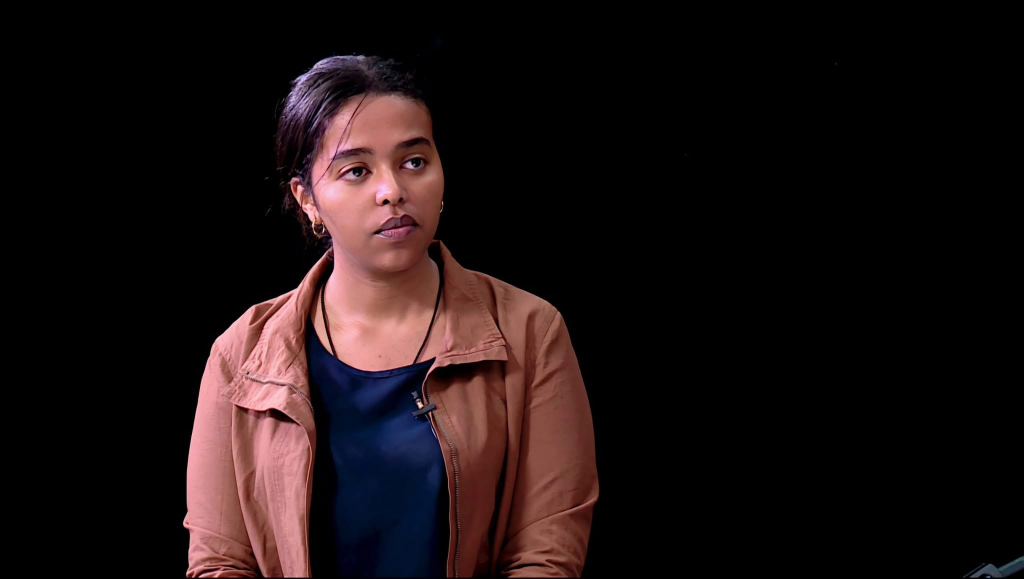
MistreSilasie Tamerat. Photo credit: Facebook/MistreSilasie Tamerat.
In the months surrounding Ethiopia’s 7th General Election in June 2026, something was happening to female political candidates that did not happen to their male counterparts at the same scale or with the same apparent coordination.
Women running for office from various backgrounds found themselves targeted by waves of online content designed not to debate their policies, but to destroy their credibility as women. These posts, many of them showing apparent signs of coordination, included fabricated images, sexualized narratives, and video material exhibiting signs of synthetic manipulation which positioned candidates in fake scenarios. And in a pattern that cannot be explained by ordinary political rivalry, these attacks came for candidates from the ruling Prosperity Party and the opposition alike.
This investigation documents that pattern across various social media platforms, including Facebook, Instagram, and X and across a period stretching from the pre-election campaign window through polling day and into the post-election period. The timeline shows that these were not spikes of opportunistic harassment at a single moment of political tension.
One of the most prominent victims of this disinformation campaign was MistreSilasie Tamirat, former broadcast journalist and coalition secretary for the Ethiopian People’s Revolutionary Party (EPRP).
Portrayed as an LGBTQ ally
Three months before the general election, political parties held the first televised debate on the Fana Broadcasting Corporation on February 22, 2026. Four parties participated in the debate, including the ruling Prosperity Party, Ethiopian Citizens for Social Justice (EZEMA), the Coalition for Ethiopia’s Unity, and the Ethiopian Social Democratic Party.
On social media, many people commended the performance of MistreSilasie Tamirat, who was a representative of the Coalition for Ethiopia’s Unity (which was formed by five parties including the EPRP), some even calling her the next first woman prime minister of Ethiopia. Despite the applause from her supporters, she faced a fabricated online attack using synthetic images and videos intended to undermine her public acceptance and voter support.
Days after the debate, a Facebook account with more than six thousand followers shared an altered image of MistreSilasie Tamirat questioning her citizenship. He also used an image of her with the flag of the LGBTQ community.

Screenshot of a Facebook post portraying MistreSilasie Tamirat as a member/ally of the LGBTQ community
However, the image’s true origin tells a different story. The original image was shared by MistreSilasie Tamirat back on October 23, 2023, when she was inside the U.S. embassy.

Screenshot of a Facebook post by MistreSilasie Tamirat, inside the U.S. Embassy in Addis Ababa
It is clear that both her clothing and the flag were altered to depict the LGBTQ community flag. The badge on her clothing and the room itself are from the U.S. Embassy in Addis Ababa’s American Space corner (also called the Satchmo Center).
Under the post featuring the altered image, some users questioned whether she understood what she was wearing, to which the account owner replied that she was “666” (a reference to a satanic symbol). Another user commented that she was a “citizen from the abyss” (likely referring to Hell). Despite some people recognizing that the image was manipulated, others reacted negatively, labeling her a member of a satanic group.
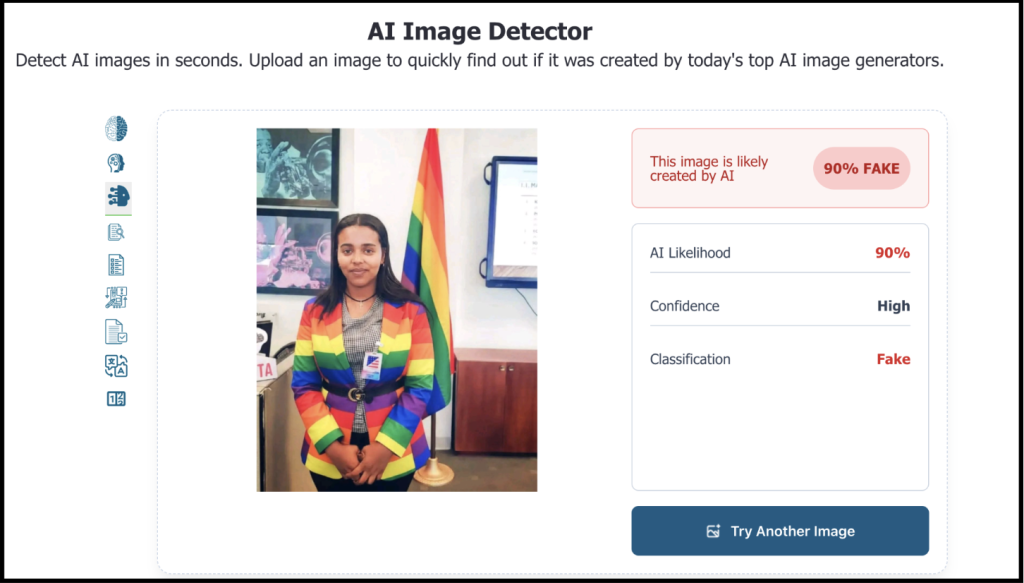
Screenshot of a check showing a high chance the image was created by AI
Homosexual acts have been illegal in Ethiopia for many years, acceptance of members of the LGBTQ community is extremely low, and the social, cultural, and legal environment is highly conservative and hostile. As a result, the spread of disinformation such as this has a tendency to tarnish the victim’s image.
Loyalty to another country?
On the same day the false LGBTQ claim was posted, an AI-generated video was shared on Instagram, showing MistreSilasie holding her passport and saying, “Yes my U.S. visa is approved, I can’t believe it. This is a dream come true.”

Screenshot of an Instagram post shared on February 25, 2026
The Instagram post used a criticizing post captioned, “Forget what this girl says, what really matters is what she does. Yesterday, a generation sat open-mouthed, listening to her sayings about the country, the struggle, and the history of the EPRP. Today, that same generation is stunned by a photo of her on American soil. But why are we surprised? When did we forget that in modern politics, speaking loudly and making a scene is often just a shortcut to filling passport pages? Instead of resharing her videos and criticizing her, maybe we should just take notes on how to fast-track a visa.”

Screenshot shows an AI-generated video (Left) and the original picture of MistreSilasie, where she’s wearing a buttonless blouse and a belt (Right)
Substance abuse and addiction
The attacks on MistreSilasie did not stop with the fabricated image; they included an effort to portray her as a drunk, smoker, and drug abuser, with some questioning her candidacy. Between March and April, manipulated and original images were published as part of a gendered smear campaign designed to portray her as a weak candidate in the election.

Screenshot of a Facebook post, original image shared on MistreSilasie’s page (Left), Altered image (Right)
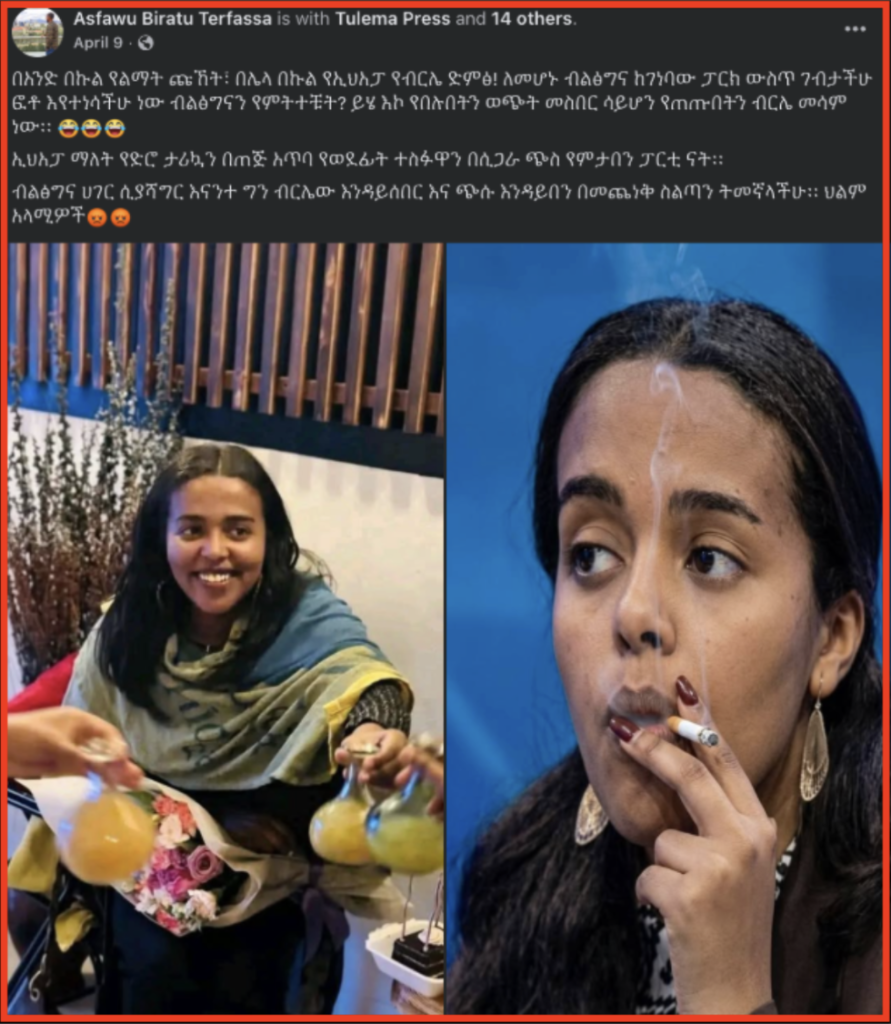
Screenshot of a Facebook post accusing MisterSilasie of being an addict
These same allegations and images were shared at various times (links 1, 2, 3, 4, 5). Some netizens expressed concern, pointing to the image of the candidate holding a flower in one hand and a drink in the other. Others argued that this image raised a critical question: which hand would MistreSilasie use to address the heavy burdens of the public? Many commented that a true leader must serve as a societal role model, guided by clear judgment rather than personal indulgence. They urged voters to reflect deeply and ensure their support goes to those genuinely committed to the community’s collective progress, often implicitly favoring the ruling party.
Far from supporting the claim of MistreSilasie as an addict, a reverse image search of the first one shows that it is a real image of her along with a yellow alcoholic drink, which is called “Tej”. Tej is a traditional honey-brewed wine that is a cultural drink in Ethiopia.
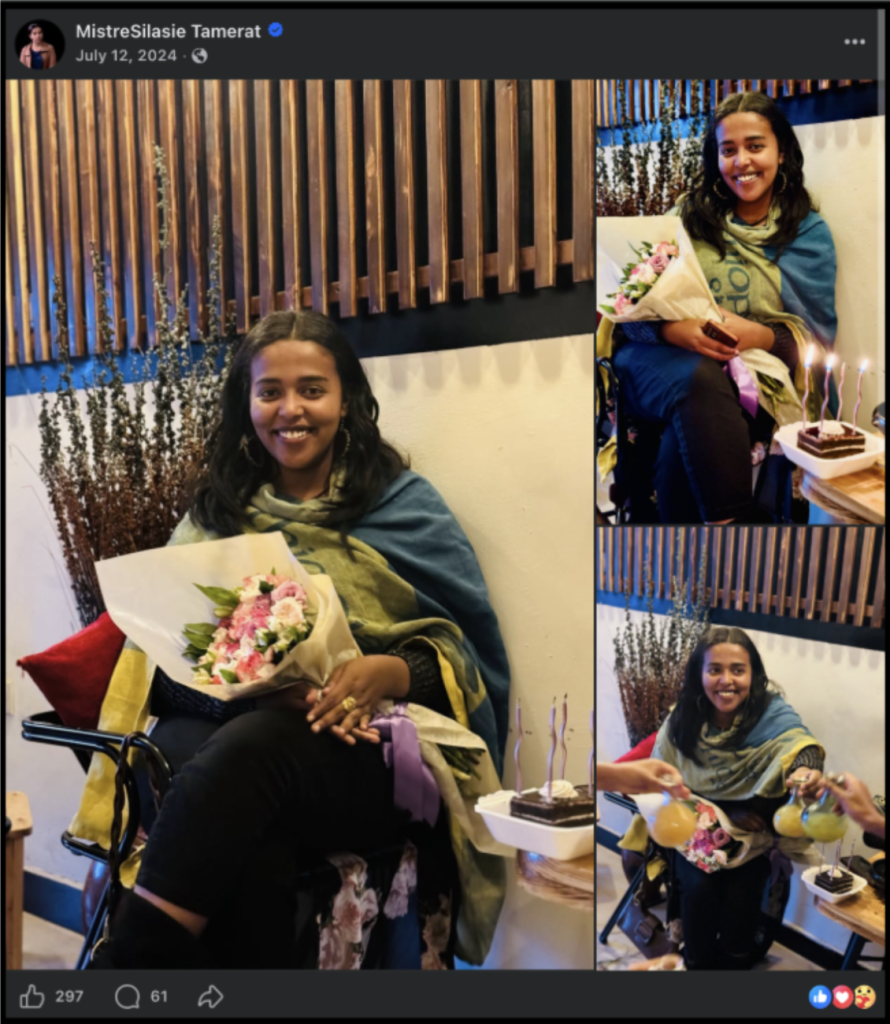
Screenshot of a Facebook post taken from MistreSilasie’s official Facebook account
An assessment confirms the post was shared on July 12, 2024, two years prior to the election. The comment section reveals it was her birthday, and a birthday cake is visible in the original post.
The second image, which shows MistreSilasie having a smoke, is altered.
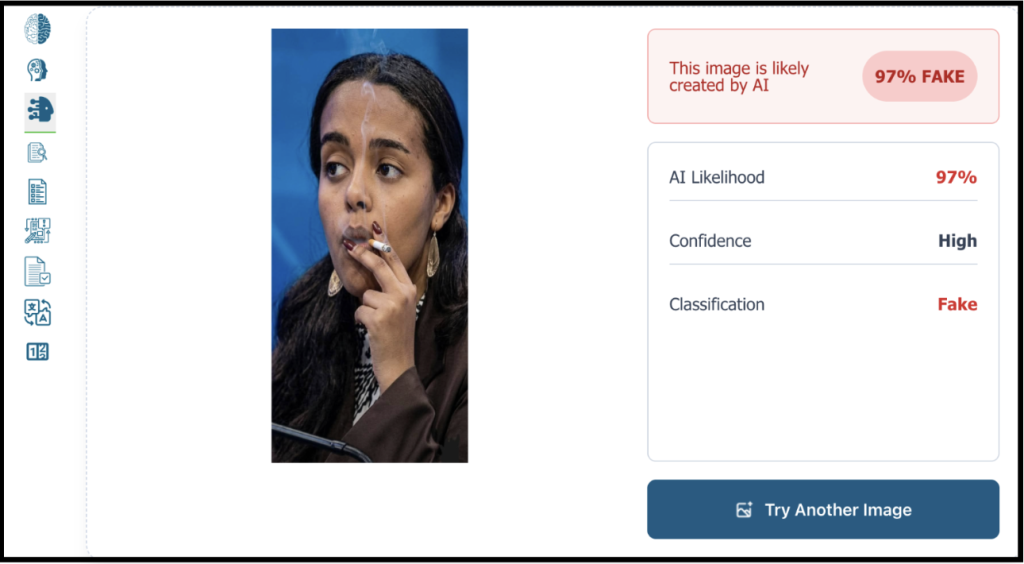
Screenshot of a check showing the image was likely created using an AI tool
In comparison with the original photo of MistreSilasie, the AI-generated photo turns out to be an attempt at character assassination through targeted manipulation. While reproducing perfectly the features of MistreSilasie that identify her teardrop-shaped filigree earrings, her patterned top, her brown blazer, and the blue background of the studio, the forgery portrays her holding a cigarette.
The candidate has been attacked through other similar narratives. For example, in what appears to be a coordinated copypasta campaign, nine accounts shared the same image and identical captions, accusing MistreSilasie of drug abuse, at least 13 times on Facebook on April 16, 2026. The posts were made mostly within minutes of each other.
The image had the words “it’s known that MistreSilasie is using Fenethyline” and showed an altered photo of MistreSilasie taking a pill, which is claimed to be a Fenethylline that eliminates fatigue, suppresses fear, and induces euphoria. It is said in these posts that she is addicted to the drug. The posts stated she was addicted to drugs, which were smuggled all the way from Syria by the chairperson of the party, Abraham Haimanot. According to the claim, “The drug is being used by the party leaders to make the young woman extremely brave, fearless, and eloquent.”
The accounts, which made this post, typically identified on the platform as digital creators, suggesting a possible financial incentive.
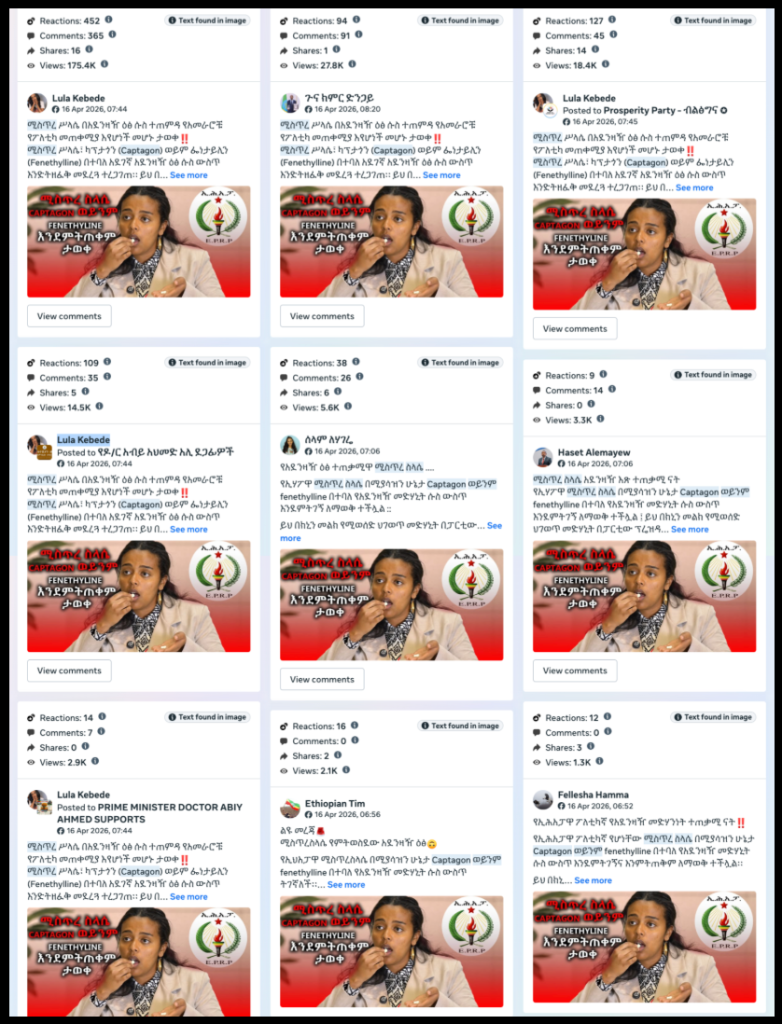
A screenshot of some of the posts sharing the image, accusing MistreSilasie of using Fenethylline. The posts were viewed over 253,000 times and recorded 589 comments. Source: Code for Africa through Meta Content Library

Screenshot of a Telegram post shared on April 16, bailing MistreSilasie as a drug addict
The coordinated allegations shared on April 16, 2026 (1, 2, 3, 4, 5) all used the altered image of MistreSilasie along with an unidentified pill, which is claimed by the posts to be fenethylline that she uses during her interviews and political debate sessions.
However, a reverse image search takes us to an interview of MistreSilasie with Borkena News, where she said the EPRP would withdraw from the election if the election were compromised. She also talked about the enabling environment of the country and the involvement of non-state armed groups in peace dialogue.
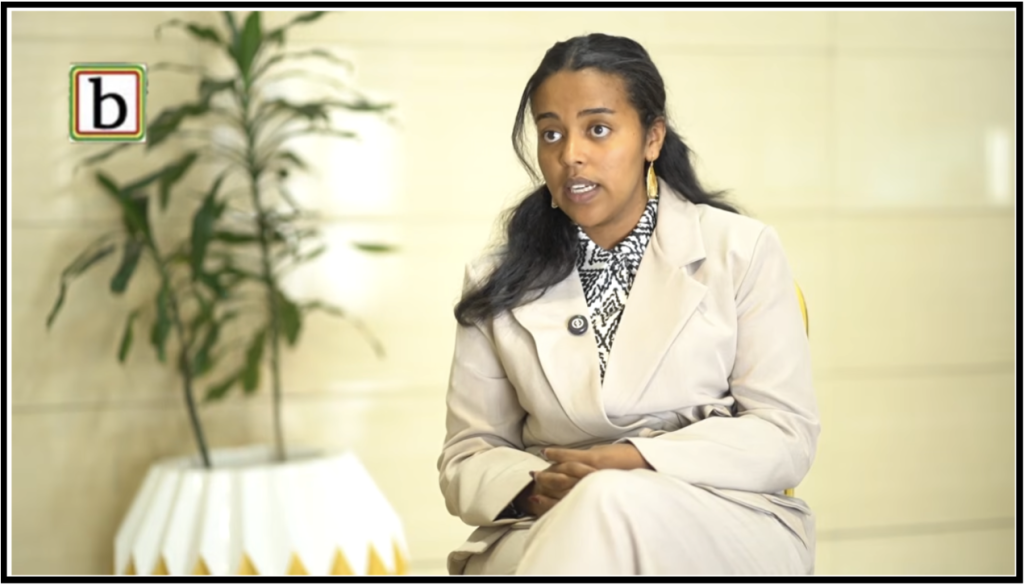
Screenshot of the original footage of MistreSilasie’s interview with Borkena News on YouTube
The clothing she wore, particularly the shirt and the tan blazer, is an exact match, indicating that the manipulated picture was obtained from the Borkena News video.
However, the background of the image was manipulated, with the original neutral background with tiles and a potted plant changed into a red gradient. Additionally, a large EPRP political logo was digitally added to the top right. Most importantly, the hand movement of MistreSilasie in the real footage was manipulated to make it appear like a hand-to-mouth movement. In the 18-minute long video, there is no scene where MistreSilasie places anything in her mouth or raises her hand that high.
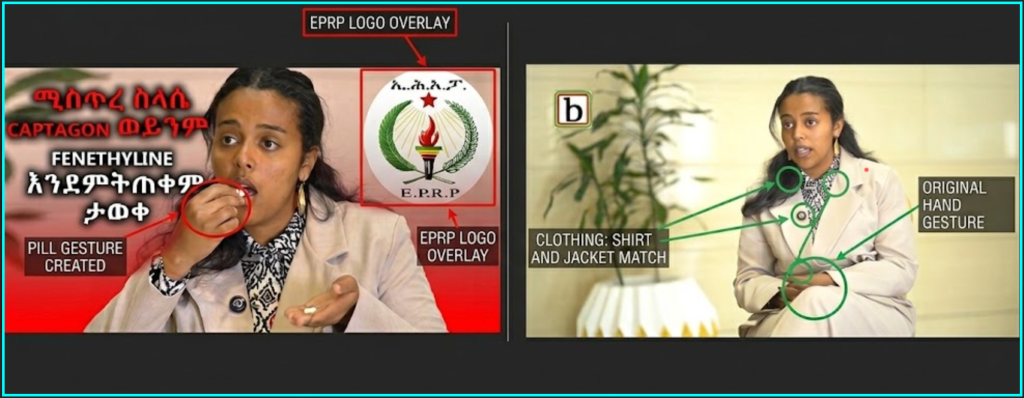
Screenshot of a comparison between the altered (left), and the original footage (right)
Allegation of sexual impropriety
In the momentum of the pre-election phase, another claim appeared that the EPRP’s struggle had shifted from street protests to a bedroom affair.
Using AI-generated images and verbatim texts, at least 13 posts by seven accounts on Facebook suggested that MistreSilasie was having an affair with the EPRP chairperson, Abraham Haimanot. The posts (1, 2, 3, 4, 5) tried to attack the party’s movement and were designed not only to attack MistreSilasie’s politics but to shame her through gendered moral judgment. The claims were first made on April 16 and then surfaced again on June 1, the day of the general election. Data from Meta Content Library also revealed that the posts had a combined viewcount of over 564,000. They also attracted 947 comments and were shared dozens of times.
The posts claimed that members of the EPRP suggested that the party’s political struggle had shifted from the public sphere to personal affairs. According to the posts, “The secret alliance between the chairman and the secretary-general has made them suffer a lot. It was told that the married man is in love with MistreSilasie. The fact that they consider love as the revolutionary target has turned into a mockery among the members of the party. The struggle that EPRP had intended to launch against the government, but it has become a bed war for them. The fact that they have been destroying their own marriage while planning to build a country proves that they are worthless for tomorrow. It has become a comedy drama of the times, and clearly indicates the political and moral failure of EPRP.”

A screenshot of some of the copypasted posts. Source: Code for Africa through Meta Content Library
These accounts that shared this narrative often post pro-government content and campaigns on Facebook, such as information relating to the Green Legacy Initiative, which was initiated by the prime minister. Some of them also post content about the ongoing conflict in the Amhara region and content about the political and military activities of the TPLF in the region.

A collage of posts, accusing MistreSilasie of having an affair with the party chairperson
The timing of these posts suggests a possible organized dissemination. Specifically, five of the posts were published in a span of only 31 minutes, starting from 4:31 PM on April 16, 2026, followed by 4:43 PM, 4:48 PM, 5:02 PM, and 5:02 PM – with two of them getting posted in the same minute.
Much more importantly, the text included in each of these posts was exactly the same. Meanwhile, images included in these posts were different for different accounts, although some images were included in more than one post. Overall, while any of these three factors could individually be explained away by coincidence, combined, they paint a picture of coordinated activity aimed at MistreSilasie Tamirat and Abrham Haimanot, the party leader.
Presented as a violent extremist
At the same time as the “bedroom affairs” posts, an online campaign alleged that the EPRP (MistreSilasie and Abraham Haimanot) sought war rather than a peaceful, free election. AI-generated and deepfake videos and images circulated on Facebook and Instagram, depicting the pair holding weapons, including an AK-47 and a grenade.
The posts that are attempting to tie the politicians to an armed aggression (1, 2, 3, 4, 5, 6) contained the sarcastic caption, “የኢሕአፓ ሰላማዊ ትግል” (The EPRP’s peaceful struggle), superimposed over a fabricated scene depicting armed individuals firing weapons at a setting staged to resemble a polling station. This creates a direct visual association between a political actor and election-period violence, a depiction that predates the actual election and did not occur.

Screenshot of a video shared online portraying MistreSilasie and Abraham Haimanot as violent
Hive Moderation’s AI-generated content detection tool returned a 99.8% probability that the video of the EPRP politicians with guns is synthetically generated. Frame-level analysis at the 00:10 mark corroborated this at 94.7% confidence, with model attribution pointing most strongly to Ray3-class and comparable video diffusion generators. Secondary signals consistent with Qwen, Ideogram, and Flux-family outputs indicate the content was likely produced through modern text to video or image to video synthesis rather than face-swap manipulation. Notably, the video’s speech component scored only 6.1% likelihood of AI generation, suggesting the visual layer was fabricated independently of the audio.

Screenshot of an AI detection result showing 99.8% of the alleged video is deepfake

Screenshot of an AI detection result and confidence score of the detection
Contemporary Ethiopian political discourse increasingly employs a dual-layered delegitimization strategy against the EPRP, blending historical trauma with modern disinformation to dismantle the party’s legitimacy.
Between 1976 and 1978, there were violent political campaigns in Ethiopia known as the Red Terror (Qey Shibir) and White Terror. The White Terror was an urban guerrilla campaign of assassinations launched by the Ethiopian People’s Revolutionary Party (EPRP) against government officials. In response, the military junta (the Derg) led by Mengistu Haile Mariam unleashed the brutal state-backed Red Terror to wipe out the opposition, killing tens of thousands of people.
Pro-government narratives frequently weaponize the party’s 1970s history, specifically the “White Terror” era of urban insurgency, to frame the modern EPRP as inherently unstable and violence-prone. This historical framing is reinforced by unverified online allegations that depict the party as a puppet of foreign entities seeking to disrupt public peace under the guise of peaceful demonstration. By conflating the memory of past ideological conflict with present-day accusations of external control and manufactured chaos, these coordinated digital narratives aim to rebrand the EPRP as a political threat.
Another AI-generated video posted online is accompanied by a caption alleging that MistreSilasie recites extremist ideas during her interviews and debates. In the footage, a man identified as Asres Mare, head of the political division for the Fano militia in the Gojjam area in Amhara region and a key public relations figure for the Amhara Fano National Movement (AFNM), is shown handing her a paper from behind a curtain while she appears to be debating.
These claims emerged after pro-government accounts alleged that her party was working hand in hand with AFNM. This followed a statement from the militia threatening to kill election contestants, leading the party to announce it would withdraw from the election if its safety could not be guaranteed.

Screenshot of an AI-generated video claiming to show MistreSilasie and Asres Mare (Fano leader)
A forensic analysis of this video using Hive Moderation’s AI-generated content detection tool returned a 97.5% probability of synthetic generation, with the opening frame (00:00) scoring even higher at 98.9% confidence. Model attribution is heavily concentrated rather than dispersed, pointing overwhelmingly to Seedance2 (81.1%), with secondary weighting toward Wan (9.5%). Both the AI-generated speech score and the deepfake (face-swap) score register at 0%, indicating no synthetic audio was detected and that this is classified as fully synthetic generative video content rather than manipulation of a genuine underlying video through face substitution.

Screenshot of an AI detection result showing 97.5% of the alleged video is deepfake
Not the only victim
MistreSilasie was not the only woman targeted in this election cycle. A parallel campaign differing in tactic but consistent in intent emerged against Fedila Biya, a representative of the ruling Prosperity Party.
Fedila Biya’s political career is marked by a meteoric rise from student activist at Jimma University to a Prosperity Party spokesperson. Initially known for her grassroots advocacy for youth and political rhetoric, she served as the Vice President of the Prosperity Party Youth Wing. Her communication skills and role in strategically planning the messaging for Ethiopia’s historic 7th General Election eventually led to her appointment as Head of the Public Relations Bureau. In addition, she was recently appointed to the board of the Ethiopian Press Organization.
Less than a month before the general election, an account on X shared this post on May 18, 2026, accompanied by the caption ‘Fedila, what happened’ and a laughing emoji. The post garnered more than 10,000 views. It featured an image of Fedila Biya in her office alongside another, half-nude picture that purportedly depicted her.

Screenshot of a post shared on X on May 18, 2026
This harassment extended to other platforms, particularly following a post on the official Prosperity Party Facebook page featuring Fedila Biya. As a prominent member of the ruling party, her public presence became a frequent target; the comment section of the post was flooded with hateful rhetoric. Netizens repeatedly engaged in body shaming, attacking her physical appearance and skin color with slurs, cruelly suggesting that this was her ‘true’ appearance without makeup.
The hostile comments under the post included: “How is your National ID (fayda) going to look like then?”, “The second one is more beautiful”, “Before and after corridor”, “The one on the right is not Fedila but Feyisa”, “This is Prosperity party’s Mask”, “She is not Fedila she is Fandiya (Animal’s Manure)”, “The Stupid”, and “a Midnight devil”.

Screenshot of a post shared on May 18, 2026
Across the cases examined in this investigation, a consistent pattern emerges: some networks and social media accounts employ synchronized timing, shared scripts, and AI-generated imagery to target female candidates through tactics rarely, if ever, deployed against their male counterparts. These campaigns did not merely spread false claims; they sought to weaponize gendered shame and fear of violence to remove women from public contention before a single vote was cast.
The consequences extend beyond the candidates named in this investigative report; each unaddressed case signals to future women considering candidacy that visibility carries a cost their male peers will not face, threatening the broader inclusivity of Ethiopia’s democratic process. Addressing this will require coordinated action from platforms accelerating detection of synthetic media, to election bodies establishing rapid response verification mechanisms, to continued monitoring by independent researchers and civil society. Left unaddressed, TFGBV violence risks becoming not an aberration of Ethiopian electoral politics, but a structural feature of it.
The 2021 report by the Ethiopian Human Rights Commission (EHRC), conducted in collaboration with UN Women, produced a critical baseline for understanding the systemic barriers to women’s political engagement in Ethiopia. The study noted that women participating as candidates, voters, and electoral officers were routinely subjected to a spectrum of psychological, physical, economic, and sexual violence. A significant finding was the prevalence of gender-motivated hate speech, both online and offline, which targeted women’s physical appearance, attire, and social lives to cause psychological harm and coercive exclusion.
The assessment highlighted institutional failures, noting that law enforcement often remained inactive or complicit in these violations, while political parties largely failed to internalize the gravity of the problem. These findings culminated in the 6 Point Human Rights Agenda, which remains a primary reference point for evaluating whether current electoral processes have successfully addressed the structural and safety-related obstacles facing women in the Ethiopian political sphere.
This trajectory of exclusion remained a critical concern in the 2026 election cycle, where TFGBV emerged as a persistent threat, showing that while the platforms and methods of harassment have become more advanced, the underlying intent to weaponize technology against women’s participation remains unchanged.
This article was written with mentorship from the African Academy for Open Source Investigations (AAOSI), as part of an initiative of the European Partnership for Democracy (EPD) and Code for Africa (CfA). For more information, visit https://disinfo.africa/.